Its My Promise:-
``NO ONE CAN GIVE BEST THEN ME``.
Profit / Loss Report Of Live Trades Given To You
* MCX Zinc +31500/-Rs.
* MCX CrudeOil -68000/-Rs.
* BankNifty +31500/-Rs.
* NaturalGas +26000/-Rs.
* HDFC Call Option -48000/-Rs.
* Nifty -82800/-Rs.
Call Now For Subscriptions ☎ +91 9980555517 📱 +91 9900017008
Given To All Clients As A Free Live Trades On The Date Of 4th November 2020
👉DIPAWALI BIG OFFER FOR HNI TRADERS🚀🎇🚀🎇
Gland Pharma's public offer aiming to raise ₹ 6,479.54 crores through the public issue is the largest pharma IPO in India. The IPO constitutes an offer for sale (OFS) of more than 1.94 crore shares by promoter Fosun Pharma Industrial Pte Ltd, 1 crore shares by Gland Celsus Bio Chemicals Pvt Ltd, 35.73 lakh shares by Empower Discretionary Trust, and 18.74 lakh shares by Nilay Discretionary Trust summing the OFS to total 3.4 crore shares. The IPO also comprises the issue of fresh shares amounting up to ₹ 1,250 crores. Applicants can bid for a maximum of 13 lots with each lot comprising 10 shares. The IPO would be open from November 9 to November 11

Reliance Industries Ltd and Saudi Aramco are resuming talks over a 20% stake sale by the Indian conglomerate in its oil-to-chemical business after a brief pause due to COVID-19 pandemic, ET Now reported on Monday, citing sources.
Both the companies were committed to the deal and Aramco wants to do physical inspection of Reliance's assets in India, the report said. in July, Reuters had reported that Reliance's stake sale in its oil-to-chemicals business to Aramco had stalled over price. Chairman and Asia's richest man Mukesh Ambani told shareholders in July that the deal had been delayed due to "unforeseen circumstances in the energy market and the COVID-19 situation."
The initial deadline for completion of the deal, announced in August 2019, was March 2020. in October reported a 15% drop in September-quarter profit on Oct. 30, as the coronavirus crisis hammered its oil business, although the company reaped double-digit revenue growth at its Jio telecom service. Reliance has approached investors to take stakes in its retail business and has already raised around $20 billion from global investors this year by selling stakes in its Jio Platforms digital business.
#PositionalHNITrades Bullion Gold & Silver / Stocks Future
After witnessing the weakest first half in decades, the Indian gold market observed another quarter of inaction. Imports picked slightly in the first two months of the quarter, with a total of 78 tonnes imported, but dwindled again in September when just nine tonnes were shipped to India. Of these 78 tonnes of fresh imports, 55 tonnes were allocated for domestic consumption. Gold demand across the supply chain was notably higher in August as several major manufacturers and retailers re-initiated gold metal loan from banks.
Scrap supply remained relatively strong in the third quarter. There were two main factors at play. Firstly, there has been a rise in distress selling due to the economic slowdown, and secondly, anecdotal evidence confirms people who bought gold during the 'demonetisation' period at an elevated price, were able to take advantage of the record gold price during the quarter to liquidate their previous purchases.
On the other hand, a notable trend since the economy restarted has been that people have been rushing to banks and NBFCs for gold loans. With the rise in the gold price, the loan to value (LTV) ratio has also risen which has therefore helped consumers to get more money on the same volume of gold. We believe banks and NBFCs will continue to benefit from these dual effects of economic slowdown and a high gold price, and hence, their portfolio in this segment will rise exponentially.
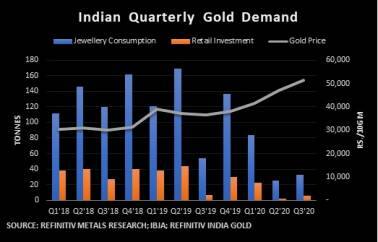
Indian gold jewellery consumption stood at just 33 tonnes in Q3, 38 percent lower than the level seen in 2019 for the same period. Demand trends oscillated quite dramatically in certain pockets of the country depending on quickly the local economies were able to rebound following the lockdowns. Retail investment demand in Q3 was down by 26 percent YoY to 5.2 tonnes. The hefty fall would have been even greater if it were not because of a low base in the previous year.
Demand for sovereign gold bonds (SGB) reached the highest quarter level since the scheme was first introduced in 2015. Reserve Bank of India data reveals 10.5 tonnes were bought in first two months of Q3, while the September number has yet to be made available. The rapid rise in the gold price, restrictions in movement, coupled with fear of moving in public spaces, may be the reason retail buyers have opted to buy gold in the form of SGB from the comfort of their homes.

As of today, Refinitiv India Gold is at Rs 51,550 per 10 gram, lower by 7 percent from the August high. The price has more or less stabilized as the festival season commences. According to market sources, footfall traffic has significantly increased after October 15th and retailers have seen a sharp rise in heavy gold purchases attributed to largely the wedding season. Local spot prices too are trading at a premium of up to $3 an ounce, further cementing the argument that demand is picking up. We believe this trend will continue through the fourth quarter of 2020.
Diversified business conglomerate ITC's nearly 20 percent drop in profits in second quarter-ended September 30, 2020 may well be masking a strategic shift towards consistently strengthening its fast-moving consumer goods (FMCG) business, a segment that has otherwise remained largely ignored among investors and analysts.
The company's net profit during the quarter fell to Rs 3,232.4 crore during the quarter, compared to Rs 4,023.1 crore in the same period last year, meeting street estimates.
Revenue from the FMCG and 'Others' segment, however, clocked a 18.4 percent growth on a comparable basis (excluding lifestyle retailing business for which restructuring is underway, as also the education and stationery products business that has been seriously impacted by the closure of educational institutions).
A disaggregated analysis points towards a strategic tilt towards FMCG in recent years.
In the current financial year during the quarter-ended September 30, 2020, EBITDA for the FMCG segment grew 66 percent, while EBITDA margins for the segment expanded 300 basis points to 9.7 percent.
In the first half of the year, it launched over 70 new products in what appears to be part of an ambitious expansion plan identifying the FMCG segment as the company's main growth driver, with focus on new products, bold acquisitions and the high-octane marketing.
In May, it announced the decision to acquire Kolkata-based spice maker Sunrise Foods Pvt. Ltd (SFPL), seen as part of a wider strategy to fortify its position in the country's highly competitive FMCG market that is dominated by large corporations such as Hindustan Unilever Limited (HUL) and several local players in diverse regional geographies.
The earnings before interest, depreciation, taxes and amortisation (EBITDA) of the new FMCG businesses has more than doubled in three years— growing from from Rs 456 crore in 2017-18 to Rs 914 crores in 2019-20.
Over an eight-year period, segment EBIDTA for the FMCG businesses has multiplied from Rs 44 crore in 2012-13, a year before current Chairman Sanjiv Puri was elevated to president of the company’s FMCG business, to Rs 914 crore in 2019-20, galloping at a compounded annual growth rate (CAGR) of 54 percent.
These may well be pointers for analysts and investors on what could be coming, particularly in the foods business with brands such as Aashirvaad (Rs 6,000 crore), Sunfeast (Rs 4,000 crore), Bingo (Rs 2,700 crore) and YiPPee (Rs 1,300 crore), achieving significant value and scale.
The restructuring of the lifestyle retailing business with the sale of the John Players brand are all measures to improve profitability of the FMCG segment.
There also appears to be a tactical shift in marketing initiatives with considerable focus on engagements with properties such as IPL, fitness and hygiene through Sunfeast, Bingo and Savlon.
LIC’s OFS Launched Sources Say, - Govt assures investors there will be no further OFS for next 2–3 years - Secured investor commitment fro...